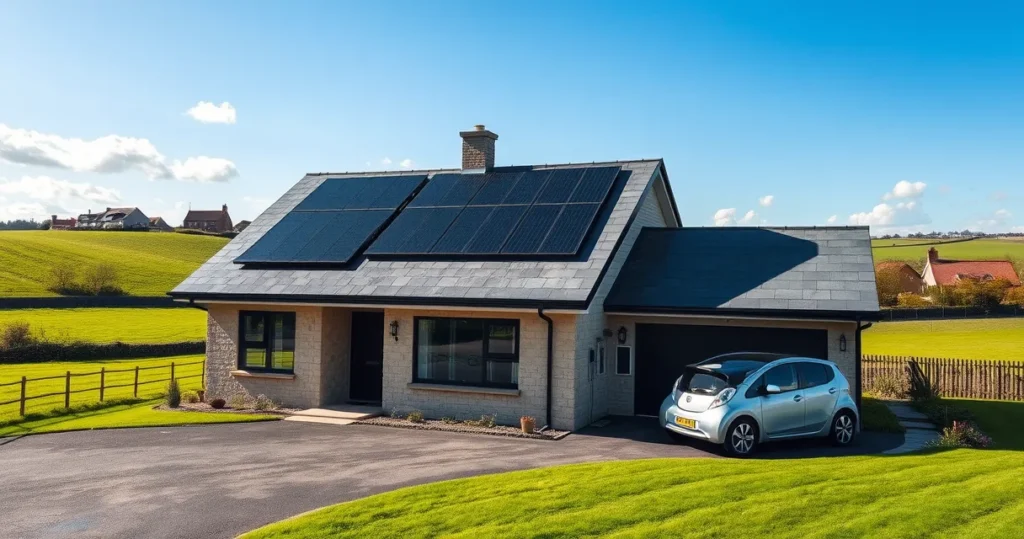
Looking to harness renewable energy in 2026? Selecting the best solar panels for your UK property is a crucial decision that will affect your energy bills, environmental impact and long-term savings for decades to come. With numerous manufacturers, technologies and installation options available, understanding which solar panels are best suited to your property, energy requirements and the UK’s variable climate can feel overwhelming.
At Oakford Integration, we specialise in designing and installing high-quality solar photovoltaic systems across Wiltshire and the South of England. Our engineers work with leading panel manufacturers to deliver efficient, durable and compliant installations for homes, businesses and public sector organisations. In this comprehensive guide, we’ll explain what to look for when choosing solar panels, discuss the key brands available in the UK market, and help you make an informed decision that delivers real value.
Whether you’re a homeowner in Salisbury, a business owner in Bristol, or managing a commercial property in Southampton, this is your expert resource on selecting the best solar panels in the UK for 2026.
Why Choosing the Right Solar Panel Matters
Not all solar panels are created equal, and the differences between products can significantly impact your system’s performance and financial return. In the UK’s climate—characterised by variable sunshine, frequent cloud cover and moderate temperatures—panel selection becomes even more critical than in sunnier regions.
High-efficiency panels generate more electricity from the same roof area, which is particularly valuable when space is limited or when maximising output from available light. Durability matters because your panels will be exposed to wind, rain, occasional hail and temperature fluctuations for 25 years or more. Panel degradation rates—how much efficiency the panel loses each year—directly affect long-term energy production and payback periods.
Choosing panels that are designed for UK conditions, backed by robust warranties and installed to MCS (Microgeneration Certification Scheme) standards ensures your investment delivers reliable performance throughout its operational life. At Oakford Integration, we work exclusively with reputable manufacturers whose products have proven track records in British installations.
Key Solar Panel Brands Available in the UK Market
The UK solar market features numerous manufacturers, but several brands have established strong reputations for quality, reliability and performance in British conditions. Here are some of the leading brands commonly available through professional installers in 2026:
LONGi
LONGi is one of the world’s largest solar manufacturers and has built a strong presence in the UK market. The company specialises in monocrystalline technology, which offers higher efficiency and better performance in lower light conditions compared to older polycrystalline alternatives. LONGi panels typically feature strong warranties and competitive pricing, making them a popular choice for both residential and commercial installations.
AIKO
AIKO manufactures high-efficiency panels known for their light weight and design versatility. Their products often incorporate advanced cell technologies that improve low-light performance—particularly beneficial in the UK—and their lighter panels can be advantageous for installations where roof loading is a concern.
REC Group
REC Group has been manufacturing solar panels for several decades and maintains a strong reputation for quality and customer support. Their panels are designed to perform reliably in varied climates and are backed by comprehensive warranties. REC panels are frequently chosen for projects where proven long-term reliability is a priority.
Canadian Solar
Canadian Solar is a well-established manufacturer with a significant presence in the UK market. They offer a broad range of panel types suitable for different applications and budgets. Their products are known for consistent quality and competitive warranties.
Panasonic
Panasonic manufactures premium solar panels renowned for high efficiency and exceptional build quality. Whilst typically positioned at the higher end of the price spectrum, Panasonic panels are often chosen by customers prioritising maximum performance and long-term durability.
It’s worth noting that the solar industry evolves rapidly, with manufacturers regularly updating their product lines. The best choice for your installation will depend on your specific requirements, budget and site conditions. Professional installers like Oakford Integration stay current with manufacturer developments and can recommend the most suitable products for your project.
Essential Features to Consider When Choosing Solar Panels
When evaluating solar panels, several technical characteristics and practical considerations should guide your decision:
Efficiency Rating
Efficiency indicates how much of the sunlight hitting a panel is converted into electricity. Modern panels typically range from around 18% to over 22% efficiency. Higher efficiency panels generate more power from the same roof area, which is particularly valuable when space is limited or when you want to maximise output from available roof orientation.
In the UK, where sunshine levels are moderate compared to sunnier climates, choosing reasonably high-efficiency panels helps ensure your system produces worthwhile amounts of electricity throughout the year, including during the lower-light winter months.
Warranty Coverage
Solar panel warranties typically cover two areas: product warranty (covering manufacturing defects and physical integrity) and performance warranty (guaranteeing minimum power output over time). Quality manufacturers generally offer 10-15 year product warranties and 25-year performance warranties guaranteeing that panels will still produce at least 80-85% of their original output after a quarter century.
Strong warranties provide peace of mind and indicate manufacturer confidence in their products’ longevity.
Temperature Coefficient
Solar panels actually become slightly less efficient as they heat up. The temperature coefficient indicates how much a panel’s output decreases for every degree above 25°C. In the UK’s moderate climate, this is less critical than in hotter countries, but panels with better (lower) temperature coefficients will perform marginally better during warm sunny days.
Durability and Build Quality
Your panels will be exposed to British weather for 25+ years, including wind, rain, occasional hail and temperature variations. Look for panels with robust frames, quality glass and appropriate certifications demonstrating they can withstand environmental stresses. Panels should be tested to relevant standards including resistance to mechanical loading, salt mist (particularly important in coastal areas) and temperature cycling.
Aesthetic Considerations
For many homeowners and businesses, visual appearance matters. Modern panels are available in various formats, including all-black models that offer a sleeker, more uniform appearance compared to traditional blue panels with visible grid lines. Whilst aesthetics don’t affect performance, they can influence planning decisions and property appearance.
Understanding Solar Panel Types and Technologies
Solar panels available in the UK market primarily use crystalline silicon technology, but there are important variations:
Monocrystalline Panels
Monocrystalline panels are manufactured from single-crystal silicon and are recognisable by their uniform dark appearance. They offer the highest efficiency ratings currently available (typically 19-23%) and tend to perform better in lower light conditions. Most premium panels in 2026 use monocrystalline technology.
Polycrystalline Panels
Polycrystalline panels use silicon from multiple crystals and have a distinctive blue, speckled appearance. Whilst historically more affordable, they’re slightly less efficient than monocrystalline alternatives and have become less common in the UK market as monocrystalline manufacturing costs have decreased.
Bifacial Panels
Some modern panels can generate electricity from both the front and rear surfaces, capturing reflected light from the ground or roof surface below. Whilst bifacial technology can increase total output in appropriate installations, the benefit depends significantly on installation configuration and ground reflectivity.
The majority of UK residential and commercial installations use standard monocrystalline panels, which offer the best balance of efficiency, proven reliability and value for money.
Solar Panel System Sizing: Matching Output to Your Needs
Determining the right system size involves balancing your energy consumption, available roof space, budget and objectives. Solar panels are rated by their maximum power output under standard test conditions, measured in watts (W). Common residential panel outputs in 2026 range from approximately 350W to 450W per panel.
For a typical UK home consuming 3,500-4,000 kWh annually, a system of around 3.5-4 kW capacity (roughly 9-12 panels depending on individual panel wattage) will generate a significant proportion of annual electricity needs. Larger homes with higher consumption, electric vehicle charging requirements or electric heating may benefit from larger systems of 5-6 kW or more.
Commercial and industrial installations are sized according to energy consumption patterns, available roof or ground space, and financial objectives. Larger businesses may install systems of 50 kW, 100 kW or considerably more.
At Oakford Integration, we conduct detailed assessments of your energy usage, roof orientation and shading before recommending appropriately sized systems that align with your requirements and budget.
Integrating Solar Panels with Battery Storage
Solar panels generate electricity during daylight hours, but household and business electricity consumption often peaks in the evening when solar generation has reduced or stopped. Without storage, excess solar electricity generated during the day is exported to the grid, typically at lower rates than the cost of importing electricity in the evening.
Battery energy storage systems allow you to store excess solar generation for use when you need it, significantly increasing self-consumption and improving financial returns. Modern lithium-ion batteries are compact, efficient and increasingly affordable, making them a worthwhile consideration for many solar installations.
Oakford Integration designs integrated solar and battery storage solutions tailored to your consumption patterns. We can install batteries alongside new solar systems or retrofit storage to existing installations. By combining generation and storage, you gain greater energy independence, protection against rising electricity prices and increased resilience during grid outages (when configured appropriately).
The Importance of Professional Installation
Even the best solar panels will underperform if poorly installed. Professional installation ensures panels are securely mounted, correctly oriented and angled for optimal performance, and that all electrical connections meet UK safety standards and building regulations.
In the UK, installations eligible for financial incentives and certain warranties must be completed by MCS-certified installers. MCS certification demonstrates that installers meet recognised competency standards and follow proper design and installation procedures.
Oakford Integration’s engineers are fully qualified and experienced in solar PV installation across residential, commercial and industrial applications. We ensure every installation complies with MCS requirements, UK building regulations and electrical safety standards. Our approach includes detailed site surveys, structural assessments where necessary, and careful system design to maximise performance whilst respecting the visual and structural integrity of your property.
We serve customers throughout Wiltshire, Hampshire, Dorset, Somerset, Gloucestershire, Berkshire, Oxfordshire and surrounding areas, including Salisbury, Bristol, Bath, Southampton, Portsmouth, Swindon, Gloucester, Reading and Oxford.
Learn more about our solar panel installation services in Wiltshire.
Additional System Components: Beyond the Panels
A complete solar PV system comprises several essential components working together:
Inverter
Solar panels generate direct current (DC) electricity, but UK homes and businesses use alternating current (AC). The inverter converts DC to AC and is often described as the brains of the system. Inverter choice affects system efficiency, monitoring capabilities and future expandability. Options include string inverters (one inverter for multiple panels), microinverters (individual inverters for each panel) and hybrid inverters (which integrate battery storage functionality).
Mounting and Racking Systems
Panels must be securely attached to your roof or ground-mounted structure using appropriate racking systems. Mounting equipment must be designed to withstand wind loading and weather exposure whilst not compromising the waterproof integrity of your roof. Quality mounting systems are engineered for the specific roof type (tile, slate, flat roof, etc.) and include appropriate weatherproofing measures.
Monitoring Systems
Modern solar installations typically include monitoring that allows you to track generation, consumption and system performance via smartphone apps or web portals. Monitoring helps you understand your energy patterns, identify any performance issues quickly and maximise the value of your investment.
Cabling and Electrical Protection
All electrical connections must meet UK wiring regulations, with appropriate cable sizing, circuit protection and isolation. Professional installation ensures electrical safety and system longevity.
Compliance, Standards and Certification
Solar installations in the UK must comply with several important standards and regulations:
- MCS Certification: Required for many financial incentives and quality assurance
- Building Regulations: Particularly Part P (electrical safety) and structural considerations
- DNO Notification: Distribution Network Operators must be notified of grid-connected installations
- Planning Permission: Most domestic installations benefit from permitted development rights, but restrictions apply in conservation areas, listed buildings and some other circumstances
Working with an established installer like Oakford Integration ensures all regulatory requirements are properly addressed, avoiding costly complications and ensuring your installation is fully compliant and properly certified.
Solar Panels for Different Property Types
Solar technology is versatile and can be adapted to various property types and applications:
Residential Properties
From small terraced homes to large detached properties, solar can be scaled appropriately. Even modest roof areas can accommodate meaningful systems, and modern high-efficiency panels make the most of limited space.
Commercial and Industrial Buildings
Businesses often have larger roof areas and daytime electricity consumption that aligns well with solar generation. Commercial installations can deliver attractive financial returns whilst demonstrating environmental responsibility.
Agricultural Buildings
Farms and agricultural businesses frequently have large barn and outbuilding roofs ideal for solar installation, often with high daytime electricity use for processing, refrigeration and other operations.
Public Sector and Educational Facilities
Schools, council buildings and other public facilities are increasingly adopting solar to reduce operating costs and meet sustainability targets.
Oakford Integration has experience across all these sectors and can design appropriate solutions regardless of property type or scale.
Financial Considerations and Return on Investment
Whilst solar panel prices have decreased significantly over the past decade, a quality installation still represents a substantial investment. However, the financial case remains compelling for most UK properties:
- Reduced Electricity Bills: Self-generated solar electricity replaces expensive grid electricity
- Export Payments: Excess generation can be exported under the Smart Export Guarantee (SEG)
- Protection Against Price Increases: Solar generation costs are fixed, protecting against future energy price rises
- Property Value: Solar installations can enhance property value and appeal
Typical payback periods for well-designed residential systems range from approximately 8-12 years, depending on electricity prices, consumption patterns and system costs. With panels lasting 25+ years, this represents many years of essentially free electricity after payback.
Commercial installations often achieve faster payback thanks to higher daytime consumption and larger system scales that benefit from economies of scale.
Why Choose Oakford Integration for Your Solar Installation
Selecting the right solar panels is important, but choosing the right installer is equally critical to your project’s success. Oakford Integration brings several important advantages:
Technical Expertise: Our engineers have extensive experience designing and installing solar systems across diverse property types and applications.
Integrated Solutions: As part of the Oakford Group, we can combine solar installation with electrical works, data infrastructure, battery storage, EV charging and other complementary services—providing genuinely integrated solutions through a single trusted partner.
Local Knowledge: Based in Wiltshire and operating throughout the South of England, we understand local conditions, building types and regional considerations.
Quality Focus: We work exclusively with reputable manufacturers and install to the highest standards, ensuring your system performs reliably for decades.
Ongoing Support: Our relationship doesn’t end at installation—we provide ongoing support, maintenance and monitoring services to protect your investment.
Take the Next Step Towards Solar Energy
Choosing the best solar panels for your UK property in 2026 means balancing efficiency, durability, warranty coverage and cost whilst ensuring professional installation that complies with all relevant standards. By selecting quality panels from established manufacturers and working with experienced installers, you can create a system that delivers reliable performance, significant financial savings and meaningful environmental benefits for 25 years or more.
At Oakford Integration, we’re committed to helping homes and businesses across Wiltshire, Hampshire, Dorset, Somerset, Gloucestershire, Berkshire and Oxfordshire harness the power of solar energy. Whether you’re taking your first steps towards renewable energy or planning a large-scale commercial installation, our team is ready to provide expert guidance and professional installation services.
Frequently asked questions
What is the 20% rule for solar panels?
The 20% rule states that solar panels should not cover more than 20% of a property’s roof area to avoid shading issues and maintain system efficiency. This ensures optimal energy production and system longevity.
Which brand of solar panels is considered the best?
Leading UK brands like Panasonic, LG, and SunPower are often considered the best due to their efficiency, durability, and warranties. Oakford Integration can recommend the most suitable brand based on your property and energy needs.
Are solar panels worth it in the UK in 2026?
Yes, solar panels are worth it in the UK in 2026. Rising energy costs and government incentives make them a smart investment. They reduce bills, increase property value, and support sustainability goals.
Is 10kW enough to run a house?
A 10kW solar system is typically sufficient for a large family home in the UK, covering most electricity needs. It can significantly reduce reliance on the grid and lower energy bills, especially when paired with battery storage.