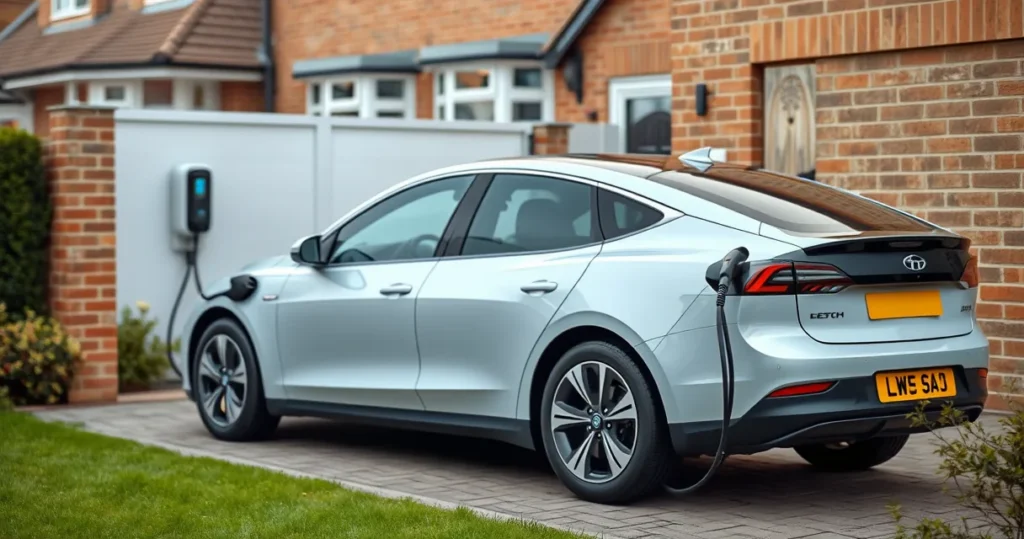
If you’re planning to upgrade to an electric vehicle in the UK, choosing the best home EV charger is one of the most important decisions you’ll make. As more drivers make the switch to EVs, having a reliable, efficient home charging solution transforms the ownership experience from potentially stressful to genuinely convenient. In this guide, we’ll walk you through the leading home EV chargers available in the UK, the critical factors you should consider when choosing one, and how to maximise the value of your investment. Whether you’re seeking a budget-friendly option or a high-end smart charger with solar integration, this guide will help you make an informed decision.
Why a Home EV Charger is Essential for UK Drivers
The UK is rapidly accelerating its transition to electric vehicles as part of the government’s commitment to ban new petrol and diesel car sales by 2035 and achieve net-zero emissions by 2050. In this context, a home EV charger has become a practical necessity for most EV owners. Here’s why installing one makes sense:
- Convenience and flexibility for daily charging: Your own EV charger eliminates the uncertainty of finding available public charging stations, allowing you to start each day with a fully charged vehicle.
- Faster, more consistent charging: Home chargers, particularly 7kW models, deliver reliable charging speeds without the queues or availability issues often encountered at public charging points.
- Significant cost savings with off-peak energy tariffs: Many UK energy providers offer special EV tariffs with substantially reduced rates during off-peak hours (typically overnight), potentially cutting your charging costs by 50% or more compared to standard rates or public charging.
- Supporting the UK’s net-zero goals: By charging your EV at home, especially when paired with renewable energy sources like solar panels, you’re directly contributing to reducing transport emissions, which currently account for around 27% of the UK’s total greenhouse gas emissions.
Key Features to Consider When Choosing a Home EV Charger
Before exploring specific models, understanding the key features that differentiate chargers will help you make the right choice for your circumstances:
Power Output: 3.6kW vs 7kW
The power output determines how quickly your EV charges:
-
3.6kW chargers typically add 12-15 miles of range per hour of charging. These are suitable for drivers with shorter commutes who can charge overnight, and they’re often the most budget-friendly option. However, they may not provide sufficient charging speed for larger battery EVs or drivers with higher daily mileage.
-
7kW chargers add approximately 25-30 miles of range per hour, making them the most popular choice for UK homes. They’re compatible with single-phase electrical supplies (standard in most UK homes) and provide a good balance between charging speed and cost. For most EV owners, a 7kW charger offers the optimal combination of convenience and value.
Tethered vs Untethered
-
Tethered chargers have an attached cable (typically 5-7 metres long), offering maximum convenience for home use. You simply plug in and charge without needing to fetch a separate cable. The downside is less flexibility if you change to an EV with a different connector type.
-
Untethered chargers have a socket rather than an attached cable, requiring you to use your vehicle’s charging cable. They offer greater flexibility and a neater appearance when not in use, but are slightly less convenient day-to-day.
Smart Charging Capabilities
Smart chargers connect to your home Wi-Fi and offer features including:
- App control and monitoring: Check charging status, view energy consumption, and start or stop charging remotely.
- Scheduled charging: Automatically charge during off-peak hours when electricity is cheapest.
- Load balancing: Prevents overloading your home’s electrical system by adjusting charging power based on other household electricity usage.
- Solar integration: Some models can prioritise charging when your solar panels are generating excess energy.
Smart chargers typically cost £100-300 more than basic models, but the energy savings and convenience often justify the investment.
Compatibility with Your EV
Most modern chargers use the Type 2 connector, which is the standard for all new EVs sold in the UK. However, it’s important to verify compatibility with your specific vehicle, particularly if you own an older EV or imported model. Check your vehicle’s onboard charger capacity as well—there’s no benefit to installing a 7kW charger if your vehicle can only accept 3.6kW.
Installation Requirements
All home EV chargers in the UK must be installed by a qualified electrician who is registered with a competent person scheme. Installation complexity varies depending on:
- Distance from your consumer unit (fuse box) to the charging location
- Whether your electrical supply requires upgrading
- Any groundworks needed for cable routing
- Additional features like outdoor sockets or dedicated consumer units
Professional installers like Oakford Integration assess these factors during a site survey and provide a comprehensive quotation covering all necessary works.
Top Home EV Chargers Available in the UK
The UK market offers numerous high-quality home EV chargers. Here are some of the most popular and well-regarded models currently available:
Premium Smart Chargers
Hypervolt Home 3 Pro – One of the UK’s most popular smart chargers, featuring excellent app functionality, solar compatibility, and sleek design. Offers dynamic load balancing and supports charging schedules to maximise off-peak tariff savings.
Ohme Home Pro – Particularly strong for tariff integration, this charger works with numerous UK energy suppliers to automatically charge during the cheapest periods. The app is intuitive and provides detailed energy usage insights.
Zappi – Manufactured by myenergi, the Zappi excels at solar integration, offering multiple charging modes including “ECO” and “ECO+” for maximising the use of self-generated renewable energy. Popular with homeowners who have solar PV systems.
Wallbox Pulsar Plus – A reliable European manufacturer offering a compact, stylish charger with comprehensive smart features and excellent build quality.
Mid-Range Options
Pod Point Solo 3 – A straightforward, reliable charger from one of the UK’s largest charging network operators. Available in both smart and standard versions, offering good value for money.
Easee One – A compact Norwegian charger with innovative design, easy installation, and comprehensive smart features. Particularly suitable for properties with limited wall space.
Andersen A2/A3 – Distinctive design with customisable front panels, allowing the charger to blend with your home’s aesthetics. Available in various colours and finishes.
Budget-Friendly Choices
For those seeking basic, reliable charging without smart features, several manufacturers offer Type 2 chargers in the £400-600 range. Whilst these lack app control and scheduling, they provide safe, effective charging for budget-conscious buyers who can manually manage charging times.
How to Choose Between 3.6kW and 7kW Chargers
Your decision between these power outputs should be based on:
Choose 3.6kW if: – You have a small-battery EV (under 40kWh) – Your daily mileage is low (under 30 miles) – You can reliably charge overnight (8+ hours) – Your home’s electrical supply cannot support 7kW – Budget is your primary concern
Choose 7kW if: – You have a medium to large-battery EV (40kWh+) – Your daily mileage varies or is regularly above 50 miles – You want flexibility to charge more quickly when needed – Your home’s electrical supply can support it (most can) – You may upgrade to a larger EV in future
For most UK households, a 7kW charger represents the better long-term investment, providing greater flexibility and future-proofing as EV batteries continue to increase in capacity.
Home EV Charger Costs and Installation in the UK
Understanding the total investment required helps with budgeting and decision-making:
Charger Costs
- Basic 7kW charger: £450-700
- Smart 7kW charger: £700-1,100
- Premium smart chargers with solar integration: £900-1,300
Installation Costs
Installation typically costs £300-800 depending on: – Distance from your consumer unit to the installation point – Whether you need a consumer unit upgrade – Cable routing complexity – Additional earthing requirements
A straightforward installation with the charger mounted near the consumer unit usually costs £300-500, whilst more complex installations requiring significant cable runs or electrical upgrades can exceed £800.
Government Support
The Office for Zero Emission Vehicles (OZEV) previously offered the Electric Vehicle Homecharge Scheme (EVHS), which has now been replaced by the EV Chargepoint Grant for flat owners and tenants. If you live in a flat or rental property and meet the eligibility criteria, you may be entitled to a grant covering 75% of installation costs up to £350. Homeowners in Scotland may be eligible for the Scottish EST Home Energy Scotland Loan scheme.
Running Costs
The cost to charge your EV at home varies significantly based on your tariff:
- Standard tariff (approx. 28p per kWh): £12-16 for a full charge (50kWh battery)
- EV-specific off-peak tariff (approx. 7-10p per kWh): £3.50-5 for a full charge
This demonstrates the substantial savings available through smart charging and appropriate tariffs.
Should You Charge Your EV to 80% or 100%?
This is one of the most common questions among new EV owners, and the answer depends on your usage patterns:
The 80% Rule
Most EV manufacturers and battery experts recommend charging to 80% for daily use because:
- Battery longevity: Lithium-ion batteries experience less stress when maintained between 20-80% charge, potentially extending battery life significantly over the vehicle’s lifetime.
- Sufficient for daily needs: For most drivers, 80% charge provides ample range for daily commuting and regular journeys.
- Faster charging: Charging speeds slow considerably above 80% as the battery management system protects the cells, so stopping at 80% saves time.
When to Charge to 100%
Charging to 100% is appropriate when: – You’re planning a long journey and need maximum range – You charge infrequently (once or twice weekly) – Your manufacturer specifically recommends it (some EVs benefit from occasional 100% charges for battery calibration)
Most smart chargers and EV apps allow you to set a charge limit, making it easy to default to 80% whilst overriding this when needed.
Why Oakford Integration for Your Home EV Charger Installation
At Oakford Integration, we specialise in the professional installation and integration of home EV charging solutions across the UK. Here’s what sets us apart:
-
Expert installation by qualified engineers: Our team comprises fully certified electricians experienced in EV charger installations, ensuring compliance with all UK regulations including BS 7671 (IET Wiring Regulations).
-
Comprehensive site surveys: We conduct thorough assessments of your property’s electrical infrastructure, providing clear recommendations and transparent quotations with no hidden costs.
-
Tailored solutions for every property: Whether you live in a detached house, terraced property, or have specific requirements like off-street parking limitations, we design solutions that work for your circumstances.
-
Solar and energy storage integration: If you have or are considering solar panels and battery storage, we can integrate your EV charger for maximum efficiency and cost savings. Learn more about our solar panel and battery storage solutions and how to power up with solar.
-
Proven track record: We’ve successfully completed numerous installations across the UK, including commercial projects such as our recent EV charging installation at Lansdowne House, Devizes, demonstrating our capability to deliver high-quality solutions in diverse settings.
-
Ongoing support: Our service doesn’t end with installation. We provide guidance on optimising your charging setup and are available for any questions or future upgrades.
For more information about our EV charging station installations, please get in touch with our team.
Frequently Asked Questions About Home EV Chargers
How long does it take to install a home EV charger?
Most installations are completed within 2-4 hours. However, if electrical upgrades or significant cable routing is required, installation may take longer or require a two-visit approach.
Do I need planning permission for a home EV charger?
Generally, no planning permission is required in England, Scotland, and Wales for domestic EV charger installations, as they fall under permitted development rights. However, restrictions may apply in conservation areas or for listed buildings. Always check with your local planning authority if you’re unsure.
Can I install an EV charger myself?
No. All fixed EV charging equipment must be installed by a qualified electrician registered with a competent person scheme. DIY installation is illegal, dangerous, and will invalidate warranties and insurance.
Will an EV charger work with my solar panels?
Many modern smart chargers can integrate with solar PV systems, allowing you to prioritise charging when your panels are generating excess electricity. This maximises self-consumption of renewable energy and further reduces charging costs. Models like the Zappi are specifically designed for optimal solar integration.
What happens if I move house?
EV chargers are typically considered fixtures and may add value to your property when selling. However, some chargers can be uninstalled and reinstalled at your new property, though this requires professional work at both locations. Check with your installer about portability options when choosing your charger.
Understanding EV Charger Connection Types and Compatibility
Not all EVs are compatible with the same charger types, and understanding the differences is key to choosing the right home EV charger. In the UK, the most common connection types are:
- Type 1 (SAE J1772): Typically used by older EV models and some Asian brands. It supports up to 7kW and is usually found on tethered home chargers.
- Type 2 (IEC 62196): The standard for most modern European EVs, including the majority of models sold in the UK. It supports up to 43kW and is ideal for home and public charging.
- CCS (Combined Charging System): Used by most new EVs and supports both AC and DC charging, allowing for higher speeds (up to 350kW). While not commonly used at home, it’s important to know if you ever use public rapid chargers.
Before purchasing a home charger, it’s essential to check your EV’s compatibility. Tethered chargers come with a built-in cable, making them more convenient for home use, while untethered models require you to use your car’s cable, offering more flexibility but less ease of use.
Always confirm with your vehicle manufacturer and charger supplier to ensure full compatibility and optimal performance.
Conclusion: Making the Right Choice for Your Home
Choosing the best home EV charger for your UK property requires careful consideration of your vehicle, charging needs, budget, and future plans. A 7kW smart charger with app control and solar compatibility represents the optimal choice for most homeowners, offering the right balance of charging speed, convenience, and long-term value.
The initial investment in a quality home charger and professional installation pays dividends through years of convenient, cost-effective charging. Combined with an appropriate EV energy tariff, home charging typically costs 60-70% less than using public charging infrastructure, with the added benefit of never needing to queue or divert from your route.
Ready to install a home EV charger? Contact Oakford Integration today for expert advice and professional installation across the UK. We’re here to help you transition to electric vehicle ownership with confidence, ensuring you have the right charging solution for your needs and circumstances.
Frequently asked questions
Which EV charger is best for home?
The best home EV charger depends on your needs, but a 7kW charger is popular for faster charging. Brands like Pod Point and ChargeFox are highly recommended for reliability and ease of use in the UK.
What is the best home EV charger in the UK according to reviews?
According to reviews, the Pod Point HomeCharge 7kW and ChargeFox 7kW are top choices in the UK for performance, smart features, and compatibility with most EVs.
Should I get a 3.6 kW or 7kW charger?
A 7kW charger charges your EV twice as fast as a 3.6kW unit, making it ideal for most home users. Choose 3.6kW only if you have a smaller battery or limited electrical capacity.
Should I charge my EV to 80% every night?
Charging to 80% nightly can help preserve your battery’s health. Full 100% charges should be occasional unless you need maximum range for a long trip.